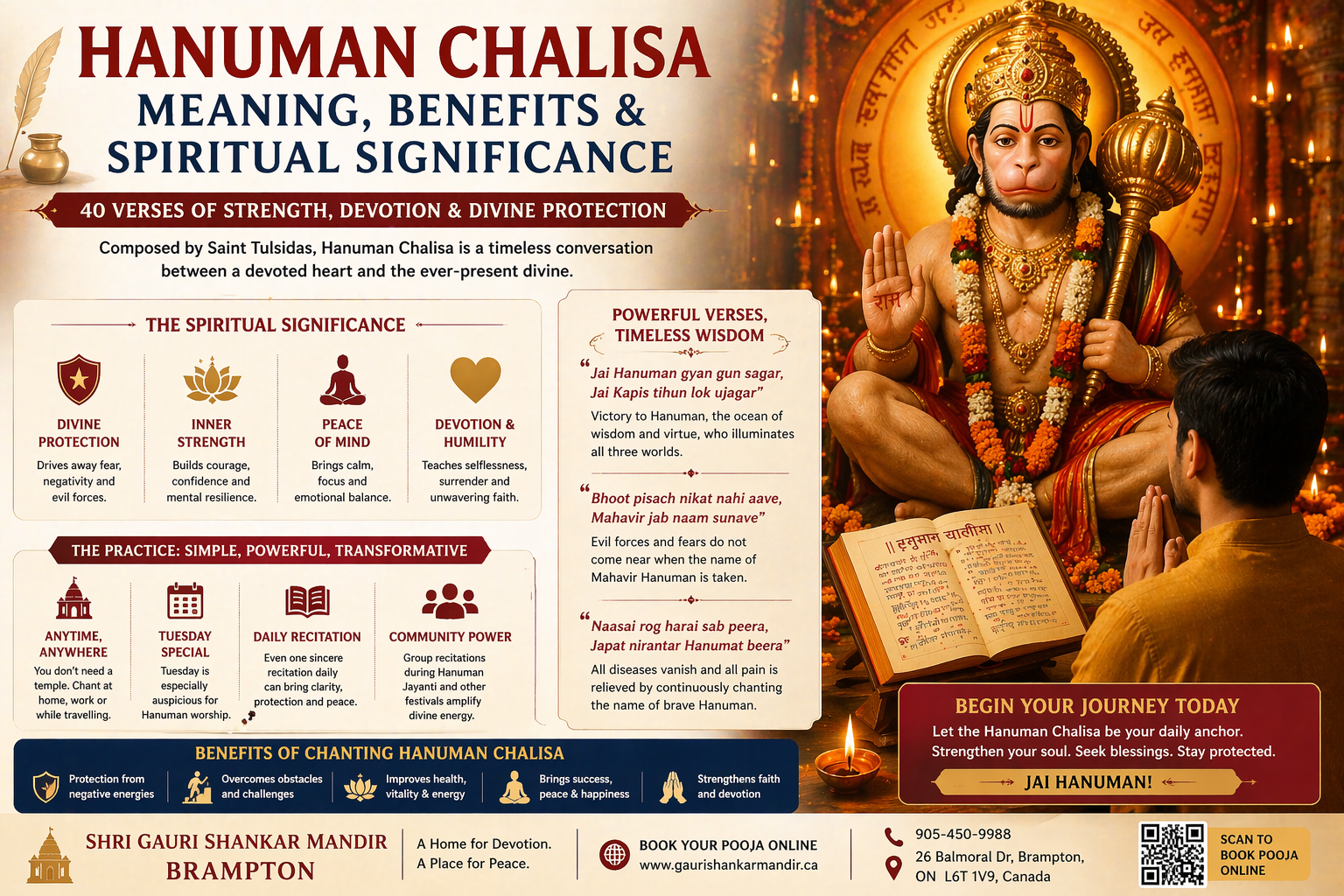
Hanuman Chalisa: A Universal Message for All
There are prayers that live on the lips, and then there are prayers that live in the soul. The Hanuman Chalisa belongs to the second kind.
Composed by the saint-poet Tulsidas in the sixteenth century, these forty verses are more than a hymn. They are a conversation between a devoted heart and an ever-present divine. Recited by millions every single day — in homes, temples, hospitals, and even prisons — the Hanuman Chalisa has quietly become one of the most universal spiritual texts the world has ever known.
What is it about these forty verses that has kept them alive for over five hundred years? The answer, as with all things truly sacred, is beautifully simple.
The Spiritual Significance of the Hanuman Chalisa
More Than a Prayer — A Portrait of the Divine
Lord Hanuman is not worshipped merely as a deity of strength. He is revered as the purest example of what a human being can become — fearless, selfless, devoted, and humble all at once. The Chalisa opens with an invocation that sets this tone immediately:
"Jai Hanuman gyan gun sagar, Jai Kapis tihun lok ujagar" (Victory to Hanuman, the ocean of wisdom and virtue, who illuminates all three worlds)
These opening words are not flattery. They are a reminder — that wisdom and virtue, not power alone, are what make Hanuman truly great. Every verse that follows builds on this foundation.
Written for Everyone, Not Just the Learned
Tulsidas wrote the Chalisa in Awadhi — the common language of ordinary people — not in Sanskrit, which was reserved for scholars and priests. This was a deliberate act of grace. He wanted every farmer, every mother, every child to access the divine without an intermediary.
That intention lives in every line even today. The Chalisa feels personal. It feels like it was written for you.
The Promise of Protection
Perhaps the most widely known verse of the Chalisa is also its most comforting:
"Bhoot pisach nikat nahi aave, Mahavir jab naam sunave" (Evil spirits and fears dare not come near, when the name of Mahavir Hanuman is taken)
For centuries, this verse has been a source of deep reassurance — not necessarily as a literal shield against supernatural forces, but as a reminder that invoking the divine with sincerity creates an inner fearlessness that no external force can easily shake.
A Universal Message Hidden in Plain Sight
Devotion Without Ego
At its heart, the Hanuman Chalisa is a meditation on what happens when a being gives themselves completely — without ego — to something greater than themselves. Lord Hanuman's devotion to Lord Rama is the thread running through every verse. But look closely, and this devotion is not blind submission. It is conscious, joyful, and full of wisdom.
"Raghupati kinhi bahut badaai, Tum mama priya Bharatahi sam bhai" (Lord Rama praised Hanuman greatly, saying — you are as dear to me as my own brother Bharat)
This verse is quietly profound. It shows that true devotion is a two-way relationship — one of love, recognition, and deep mutual respect. Hanuman served not out of compulsion, but out of pure love.
Strength That Comes From Surrender
The Chalisa holds a verse that speaks directly to human limitation and divine grace:
"Naasai rog harai sab peera, Japat nirantar Hanumat beera" (All diseases vanish and all pain is relieved, for those who continuously chant the name of the brave Hanuman)
This is perhaps why the Chalisa resonates far beyond the Hindu faith. It speaks to something universally human — the experience of feeling small, overwhelmed, or broken — and offers not a solution, but a hand to hold. It does not promise that life will stop being difficult. It promises that you will not have to face it alone.
The Practice: Simple, Powerful, Transformative
You Do Not Need a Temple to Begin
You need no priest, no elaborate ritual, no special preparation. The Hanuman Chalisa meets you exactly where you are — in your kitchen, on your commute, in the quiet of 5 AM when the world is still asleep.
Many devotees begin simply by listening. Others read it slowly, one verse at a time. Some commit it to memory over weeks, finding that the memorization itself becomes a form of meditation. There is no wrong way. The only requirement is sincerity.
The Power of Tuesday Practice
Tuesdays hold special significance in Hanuman worship. Many devotees who recite the Chalisa every Tuesday report a particular sense of clarity, protection, and groundedness that carries through the entire week.
If you are new to the Chalisa, begin with one recitation a day. Give it thirty days. Notice what shifts — not just spiritually, but in your patience, your resilience, and your relationship with fear.
When the Chalisa Becomes a Community
During festivals like Hanuman Jayanti, communal recitations create an atmosphere impossible to describe in words. Hundreds of voices rising together — the sound itself becoming a kind of collective blessing. In those moments, the Chalisa stops being a personal prayer and becomes something much larger. A shared heartbeat. A communal offering.
What Devotees Experience
The Quiet Anchor
Ask anyone who recites the Hanuman Chalisa regularly and they will say the same thing in different words — it anchors them. A student in the middle of exams. A parent navigating a crisis. An elderly person sitting alone at dawn. The Chalisa holds them all, equally, without judgment.
The Closing Verse — A Seal of Grace
The Chalisa ends with a verse that feels like a gentle hand placed on the shoulder:
"Jo sat baar paath kar koi, Chhutahi bandi maha sukh hoi" (Whoever recites this one hundred times is freed from bondage and attains great bliss)
Tulsidas is not speaking only of physical bondage. He is speaking of the bondage of fear, of grief, of ego, of self-doubt. The Chalisa, recited with faith and consistency, is said to gradually loosen these invisible chains — and that is a liberation available to absolutely everyone.
Closing Blessing & A Gentle Invitation
May every verse you recite bring you a little closer to the stillness within. May Lord Hanuman's grace walk beside you — on ordinary days and the difficult ones alike.
If you ever feel called to experience the Chalisa in a warm, collective, devotional setting, Shri Gauri Shankar Mandir in Brampton welcomes you with open doors. The mandir holds regular Chalisa recitations and pujas throughout the year. For those who cannot visit in person, online pooja booking is also available — because divine blessings know no distance.
Jai Bajrang Bali. Har Har Mahadev.
Frequently Asked Questions
1. Do I need to be Hindu to recite the Hanuman Chalisa?
Not at all. The Chalisa is rooted in devotion and universal human values. Anyone who approaches it with sincerity and an open heart is welcome to recite it, regardless of faith or background.
2. How long does one recitation of the Hanuman Chalisa take?
A single recitation typically takes between 10 to 15 minutes. With regular practice, many devotees complete it in 7 to 8 minutes — making it easy to fit into even the busiest day.
3. Is it necessary to understand the meaning to benefit from it?
Understanding deepens the experience, but it is not required. Even the sound and rhythm of the verses carry a meditative, calming quality. Reading a simple translation alongside the recitation can make it an even more moving experience.
4. Which day is most auspicious for reciting the Hanuman Chalisa?
Tuesday and Saturday are traditionally associated with Lord Hanuman and considered especially auspicious. That said, the Chalisa can be recited any day — morning or evening — with sincere devotion.
5. Can the Hanuman Chalisa be recited during difficult or inauspicious times?
Absolutely — and this is precisely when most devotees turn to it. The Chalisa is widely regarded as a source of protection and inner courage during times of fear, grief, illness, or uncertainty. There is no restriction on when it can be recited.