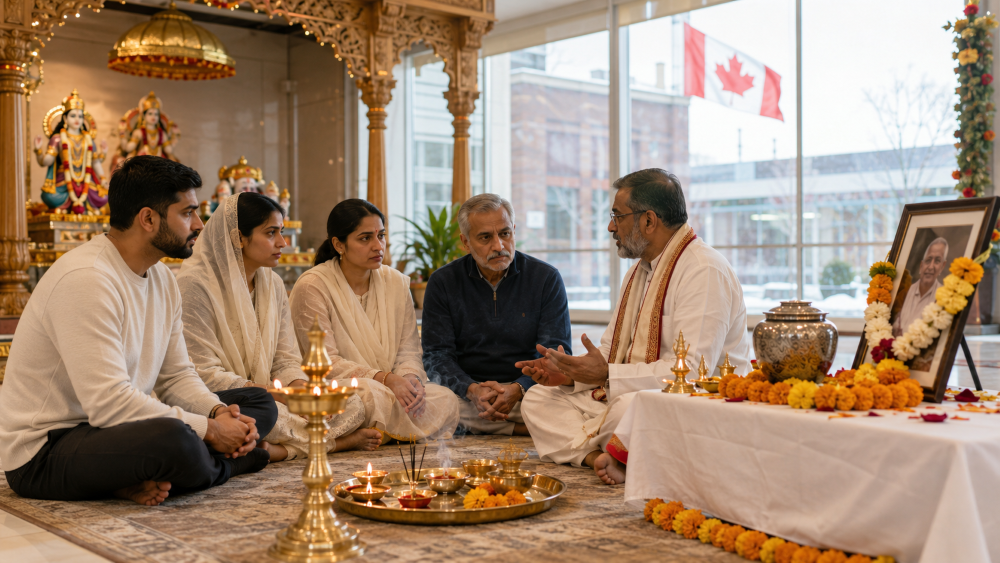
Hindu Last Rites in Canada: What Grieving Families Need to Know
Grief is already the hardest thing a person carries.
But for Hindu families living in Canada, it often comes with a second weight.
You are far from home. Your elders are not in the next room. The river you have always known is an ocean away. And you are trying to do right by someone you love, without knowing exactly how.
That quiet fear of not honouring the departed correctly is real. And it deserves to be spoken about openly.
This blog is for every family who has faced that moment, or who wants to understand what lies ahead before it arrives.
Why Loss Feels Different When You Are Living Abroad
In India, loss is held by a whole village.
Extended family arrives. Priests are called. Neighbours bring food. Elders guide every step of Antyeshti without you having to ask.
In Canada, that network is smaller. Family may be hours away by flight. The procedures here look different. And the quiet rituals that once happened naturally now need to be planned, arranged, and understood from scratch.
This is not a failure of devotion. It is simply the reality of life in a new country.
What most families need is not a longer ritual. They need someone to gently walk them through what to do, why it matters, and where to begin.
What Antyeshti Means and Why Every Step Carries Weight
Antyeshti is the final Sanskar. The last sacred rite in a human life.
In Sanatan Dharma, the soul does not simply leave. It transitions. And this transition needs to be supported with care, prayer, and the right rituals performed at the right time.
Antyeshti is not just a farewell. It is the family's way of saying: we are here with you, even now.
The rituals include prayers for the peace of the departed soul, mantras to ease the journey ahead, and offerings made with love and intention.
When performed with sincerity, even in a new land, these rites carry the same sacred weight they always have.
How Antyeshti Is Performed in Canada
Canadian cremation and funeral procedures follow their own legal timelines. This can feel disorienting when you are also trying to observe Hindu rites.
The good news is that Vedic rituals can be adapted with care, without losing their meaning.
A knowledgeable priest at a Hindu temple in Brampton can guide families through each stage. From the initial prayers at the time of passing, to the Shanti Path performed for peace and healing, the process is structured with compassion.
Shanti Path, in particular, offers enormous comfort. It is a prayer not only for the departed, but for the family left behind. It brings stillness into a moment that often feels like chaos.
Many families are surprised to find that the rituals, when guided properly, bring a sense of relief rather than added pressure. They give grief a shape. And that shape helps.
Asthi Visarjan: When the Ganga Is Not Within Reach
After the cremation, many families carry the question of the ashes quietly and alone.
In India, the natural next step is Asthi Visarjan. Immersing the ashes in a sacred river. The Ganga, Yamuna, or a river near the family's ancestral home.
But what happens when you are in Brampton, and that river is thousands of kilometres away?
This is where many families carry silent guilt. They worry that performing Visarjan in Canadian waters is not valid. That it will not honour the soul properly.
That guilt is understandable. But it is not necessary.
Our scriptures speak of all flowing water as sacred. The intention behind the act, the love, the prayer, the sincerity, is what carries the soul forward. Many families have performed Asthi Visarjan in the lakes and rivers of Ontario with the guidance of a priest, and found genuine peace in it.
If travelling to India for immersion in the Ganga is possible and desired, a priest at a temple in Brampton can also guide you on the preparations required for that journey.
Both paths are valid. Both are full of love.
Who This Guidance Is For
This is for families who have just experienced a loss and do not know where to begin.
It is for families who want to understand the process before they need it, so that when the time comes, they are not making decisions in grief alone.
It is for children raised in Canada who want to honour their parents according to our traditions, even if they were not raised knowing every step.
And it is for the devoted son or daughter who could not fly back in time, who is carrying that pain, and who needs to know that honouring a soul from where you stand is still meaningful.
The place does not determine the depth of your love. The prayer does.
The Ongoing Rituals: Monthly Shradh and Annual Remembrance
Antyeshti and Asthi Visarjan are the beginning, not the end, of remembering.
Hindu tradition offers ongoing rituals for remembrance. Monthly Shradh, Pitru Paksha observances, and annual remembrance rites keep the connection between the living and the departed alive.
These practices help families grieve with grace. They give sorrow a rhythm.
At the Hindu mandir in Brampton, priests are available to guide families through these ongoing observances. You do not have to figure it out alone each year. Everything is already there, waiting for you.
Where to Turn When You Need Guidance
Shri Gauri Shankar Mandir, a trusted Hindu temple in Brampton, has experienced priests who are trained in Vedic last rites. They understand both the sacred requirements of our tradition and the practical realities of life in Canada.
When you reach out, you will not be handed a checklist. You will be guided, gently, one step at a time.
The temple is also a space for the family to gather in the days that follow. To offer prayers together. To find stillness in the community.
Grief shared in a sacred space feels different from grief carried alone.
You Have Not Failed Your Loved One
If you are reading this carrying any guilt, about the distance, the timing, the rituals you did or did not know, please set it down.
The fact that you are searching, asking, trying to understand, is itself an act of love.
Our tradition has always known that life takes people away from home. It has always offered a way to honour those we love from wherever we stand.
You do not need the Ganga in your backyard to hold your loved one's soul with reverence.
You need intention. You need prayer. And you need someone to walk beside you.
That is what the temple is here for.
If your family is navigating loss and needs guidance on Antyeshti, Shanti Path, or Asthi Visarjan, you are welcome to reach out to Shri Gauri Shankar Mandir. Our priests will walk with you through every step, with care and without rush.
Frequently Asked Questions
Q1) Can Hindu last rites be performed in Canada according to Vedic tradition?
Yes. Vedic rites can be adapted for the Canadian context without losing their meaning. A trained priest will guide your family through each step in accordance with tradition.
Q2) Is Asthi Visarjan valid if performed in a Canadian river or lake?
Yes. All flowing water is considered sacred in our tradition. The sincerity of prayer and the intention behind the act are what give the ritual its meaning. Many families have found deep peace in performing Visarjan in local waters.
Q3) What is Shanti Path and when is it performed?
Shanti Path is a series of prayers offered for the peace of the departed soul and for the healing of the grieving family. It is typically performed in the days following the passing and can be arranged through the temple.
Q4) Can we perform Shradh and annual remembrance rites at the temple?
Yes. Shri Gauri Shankar Mandir offers ongoing guidance for monthly Shradh and Pitru Paksha observances. You can contact the temple to plan these rituals with the support of our priests.
Q5) How do we reach out to the temple if we need immediate guidance after a loss?
You can contact Shri Gauri Shankar Mandir directly at info@sgsm.ca or call +1 647 870 7100. Our priests will respond with care and help you arrange what is needed, on your timeline.