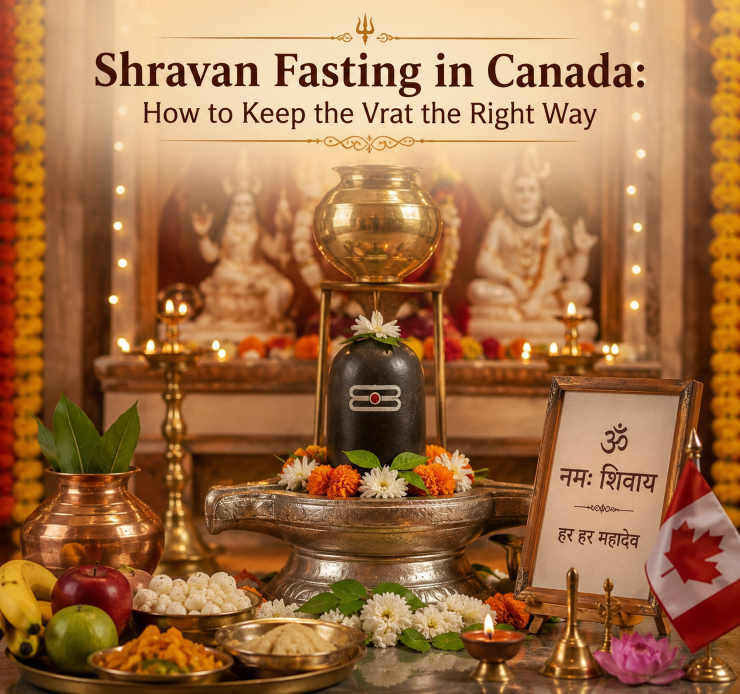
Shravan Fasting in Canada: How to Keep the Vrat the Right Way
For millions of Hindu families living in Canada, Shravan carries a feeling that no other month does. It is the most sacred month of the year for devotees of Lord Shiva. And the distance from India does not make it feel any less important. If anything, it makes the longing to observe it correctly feel even stronger.
This guide is for every bhakt who wants to keep the Shravan Vrat with full sincerity, right here in Canada, without the confusion of not knowing what is allowed, what is not, and how to manage it all alongside a busy Canadian life.
Why Shravan Is Mahadev's Most Beloved Month
There is a reason Shravan holds the highest place in the Shiva Purana.
According to our scriptures, during the Samudra Manthan, the churning of the cosmic ocean, a deadly poison called Halahal emerged. To protect the world, Lord Shiva consumed it entirely. Goddess Parvati stopped it from reaching his stomach by pressing her hand against his throat. The poison turned his throat blue, giving him the name Neelkantha.
The gods then bathed Mahadev with the sacred waters of the Ganga to soothe and cool him. That offering of water during Shravan became the foundation of the Jalaabhishek tradition we continue to this day.
Shravan is the month Shiva held the world's pain so others would not have to. So, worshipping him during this time is not just a ritual. It is gratitude.
Who Observes the Shravan Fast?
The Shravan Vrat is observed by many, for many different reasons.
- Unmarried women observe it to seek Mahadev's blessings for a devoted and loving husband
- Married women fast to pray for their husband's long life and the wellbeing of the family
- Devotees of Lord Shiva fast every Monday throughout the month as an act of surrender and love
- Those going through difficult phases such as Sade Sati or health challenges turn to Shravan as a month of renewal and grace
- Young adults raised in Canada observe it to stay connected to their roots and honour the tradition their parents carried across the ocean
Whatever your reason is, it is enough.
What You Can Eat During Shravan Fasting
This is where most people are confused about, especially those who have no elders to ask.
Here is a clear guide to what is permitted:
| Allowed During Shravan Fast | Where to Find It in Brampton/GTA |
| Sabudana (tapioca pearls) | Indian grocery stores, Oceans Fresh Food Market |
| Sendha namak (rock salt) | Indian grocery stores, health food stores |
| Fresh fruits (banana, apple, mango, papaya) | Any grocery store |
| Milk, curd, paneer | Any grocery store |
| Potatoes and sweet potatoes | Any grocery store |
| Buckwheat flour (kuttu ka atta) | Indian grocery stores |
| Singhare ka atta (water chestnut flour) | Indian grocery stores |
| Dry fruits and nuts | Any grocery store |
| Coconut and coconut water | Any grocery store |
A few easy meals to prepare:
- Sabudana khichdi with peanuts and sendha namak
- Fruit chaat with rock salt and lemon
- Kuttu ki puri with curd
- Boiled or roasted sweet potato with ghee
- Makhana (fox nuts) roasted in ghee
What Must Be Avoided and Why
| Not Allowed During Shravan Fast | Why |
| Non-vegetarian food | Shravan is a month of sattvic living and compassion |
| Regular table salt (iodised) | Considered tamasic during fasting; sendha namak is used instead |
| Grains like wheat and rice | Grains are given up as part of the fast |
| Onion and garlic | Considered rajasic, they are believed to increase agitation of the mind |
| Alcohol and tobacco | These cloud the mind and dull spiritual awareness |
| Eggplant (brinjal) | Traditionally avoided during Shravan in many communities |
These are not arbitrary restrictions. Every item avoided during Shravan is connected to the idea of giving your body and mind a cleaner, calmer state. The fast is as much for the mind as it is for the stomach.
Fasting on a 9-to-5 Schedule: Making It Work
This is the real challenge for most bhakts in Canada.
You have a full workday. You cannot cook an elaborate meal at noon. And breaking your fast at 6 PM in an office break room is not exactly the setting you imagined.
Here is how to make it work without compromising your Vrat:
- Prepare the night before. Roasted makhana, dry fruits, and fruit can be packed easily and eaten at your desk without cooking.
- Carry a small tiffin. Boiled sweet potato with sendha namak and ghee travels well and keeps you full.
- Sabudana khichdi can be made in the morning and carried in a thermos or container.
- A banana and a small box of curd is enough for a midday meal if you are pressed for time.
- Break the fast in the evening with your family. Light a diya, offer water to the Shivling at home or at the mandir, say your prayer, and then eat together.
The effort of fasting while working is itself your offering to Mahadev. He sees it.
The Right Way to Begin and End the Shravan Vrat
Many bhakts worry about doing it correctly without an elder guiding them. Here is a simple, sincere approach:
In the morning:
- Wake up, bathe, and wear clean clothes
- Light a diya and offer water or milk to the Shivling at home
- Chant Om Namah Shivaya 108 times or as many times as feels right
- Set your sankalp, your intention, for the day
In the evening:
- Offer the evening aarti to Mahadev
- Recite the Shiva Chalisa or Mahamrityunjaya Mantra
- Break your fast after the aarti with a sattvic meal
You do not need a perfectly decorated altar or a pandit present every day. A clean space, a sincere heart, and a lit diya are enough.