The Sacred Sound of Om Namah Shivaya: Understanding the Panchakshari Mantra
There are certain sounds in the spiritual traditions of India that carry a presence beyond words. Among them, “Om Namah Shivaya” holds a special place in the hearts of devotees and seekers alike. Softly chanted in temples, whispered during meditation, or repeated in silent prayer, this mantra has echoed through centuries as one of the most sacred invocations of Lord Shiva.
Yet the beauty of Om Namah Shivaya lies not only in its simplicity but also in its profound depth. Known as the Panchakshari Mantra, meaning the “five-syllabled mantra,” it carries layers of spiritual meaning rooted in ancient scriptures, yogic wisdom, and the subtle rhythms of the natural world.
To chant this mantra is not merely to repeat sacred words—it is to align oneself with the very principles that sustain the universe.
The Ancient Origins in the Krishna Yajurveda
The mantra “Namah Shivaya” traces its origins to the Krishna Yajurveda, one of the four Vedas that form the foundation of Hindu spiritual knowledge.
Within the Vedic hymn known as the Sri Rudram, Lord Shiva is invoked in many forms—as the force within nature, the protector of life, and the ultimate consciousness that pervades the universe. It is in these sacred verses that the essence of the Panchakshari mantra appears.
Over time, sages and spiritual practitioners recognised the immense power contained in this simple phrase. When preceded by the primordial sound Om, the mantra becomes Om Namah Shivaya, an invocation that expresses surrender to the divine presence of Shiva.
In Sanskrit, the phrase translates gently as:
“I bow to Shiva.”
Yet this translation captures only a fraction of its deeper meaning. The mantra is less about worship from a distance and more about recognising the divine consciousness that exists both within the universe and within oneself.
Om Namah Shivaya Meaning — the Five Sacred Syllables
The Panchakshari mantra is built upon five syllables:
Na – Ma – Shi – Va – Ya
Each syllable carries spiritual symbolism and represents a subtle aspect of existence.
Na is associated with the earth element and represents stability, grounding, and the foundation of life.
Ma is connected to water, symbolizing flow, purification, and emotional depth.
Shi represents fire, the transformative force that brings light, clarity, and inner awakening.
Va corresponds to air, the element of movement, breath, and vitality.
Ya represents space or ether—the infinite expanse in which all creation unfolds.
Together, these syllables form a sacred rhythm that reflects the structure of the cosmos itself.
When a devotee chants Om Namah Shivaya, they symbolically honor the presence of Shiva within these five elements, acknowledging that the divine permeates every aspect of existence.
The Connection with the Pancha Mahabhutas
In Hindu philosophy, the universe is composed of five fundamental elements known as the Pancha Mahabhutas:
- Earth (Prithvi)
- Water (Jala)
- Fire (Agni)
- Air (Vayu)
- Space (Akasha)
These elements are not merely physical substances; they represent the subtle building blocks of creation. Everything in the universe—from mountains and rivers to the human body and mind—arises from their interplay.
The Panchakshari mantra reflects this cosmic structure. Each syllable resonates with one of the elements, making the mantra a spiritual bridge between the individual and the universe.
Through chanting, devotees symbolically purify these elements within themselves. The mind becomes calmer, the breath steadier, and awareness begins to expand.
This is why many spiritual teachers describe Om Namah Shivaya as a mantra that harmonizes both the inner and outer worlds.
The Role of the Mantra in Yogic Traditions
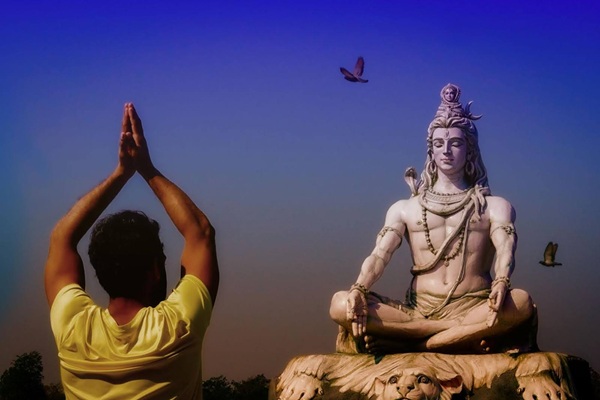
Beyond temple worship, Om Namah Shivaya holds a significant place in yogic practice.
In many traditions of yoga and meditation, the repetition of sacred sounds—known as mantra japa—is used to quiet the restless mind. The rhythmic chanting of a mantra helps focus attention, gradually leading the practitioner into deeper states of awareness.
Within Shaivite and yogic traditions, the Panchakshari mantra is often associated with inner purification and spiritual awakening.
Practitioners may chant the mantra while:
- Sitting in meditation
- Practicing pranayama (breath control)
- Using a rudraksha mala for mantra repetition
- Reflecting quietly on the nature of consciousness
As the mantra is repeated, the mind begins to settle. Thoughts slow down, breathing becomes gentle, and awareness moves inward.
Over time, this simple practice can transform chanting into a deeply meditative experience, where the sound of the mantra seems to arise naturally from within.
A Mantra That Transcends Time
One of the remarkable qualities of Om Namah Shivaya is its universality. The mantra does not require elaborate rituals or complex understanding. Its power lies in its sincerity and repetition.
For centuries, saints, yogis, and householders alike have turned to this mantra as a source of strength and clarity. Whether chanted softly at dawn, repeated during prayer, or whispered during moments of reflection, it has offered countless seekers a path toward inner stillness.
In the sacred traditions of Shaivism, the mantra is often regarded as a direct expression of the presence of Shiva—the consciousness that exists beyond form, beyond time, and beyond all divisions.
The Gentle Path of Sound and Silence
Spiritual traditions often describe the journey toward inner peace as a movement from noise toward silence. Mantras serve as a bridge along that path.
The repetition of Om Namah Shivaya gradually leads the mind from scattered thoughts toward a calm, centered awareness. In that quiet space, one begins to sense the deeper harmony that flows through all creation.
For devotees, the mantra becomes more than a chant. It becomes a reminder of the sacred rhythm of life—the balance of elements, the presence of divine consciousness, and the unity that connects all beings.
In its five simple syllables, the Panchakshari mantra carries a timeless invitation:
to pause, to listen, and to rediscover the stillness where Shiva resides within the heart of every seeker.