Maa Lakshmi, Saraswati and Durga: Why Navratri Honours All Three
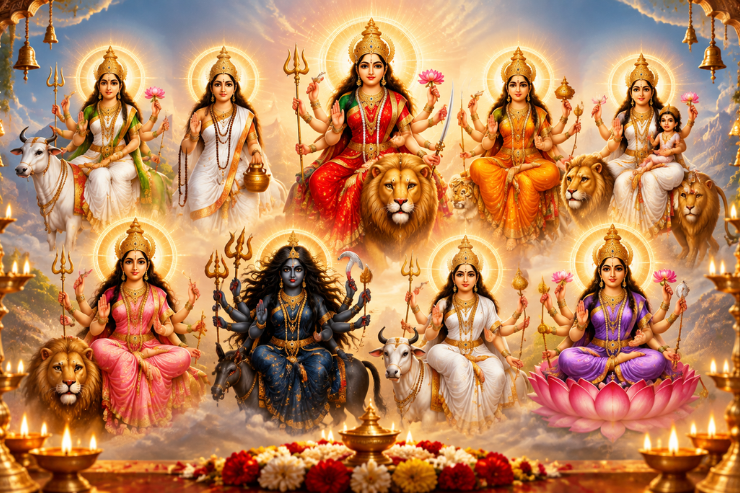
Navratri is not just for Maa Durga. Very few bhakts know that the nine sacred nights are intentionally divided among three goddesses. Maa Durga, Maa Lakshmi, and Maa Saraswati each hold three nights. And together, they guide every devotee through a complete spiritual journey, one that begins with strength and ends with wisdom. This blog is your guide to all three.
Navratri Is Not Just Maa Durga's Festival
The nine nights of Navratri are not nine repetitions of the same prayer. They are a structured, intentional journey across three phases of inner transformation.
Our scriptures describe the supreme power, Shakti, as existing in three forms:
- Kriya Shakti: the power of action and doing
- Dravya Shakti: the power of wealth and abundance
- Gyan Shakti: the power of knowledge and wisdom
Each phase of Navratri honours one of these three powers. And each is represented by one goddess.
The Three Phases of Navratri at a Glance
| Nights | Goddess | Shakti | What It Represents |
| Night 1, 2, 3 | Maa Durga (Mahakali) | Kriya Shakti | Action, courage, clearing what no longer serves |
| Night 4, 5, 6 | Maa Lakshmi | Dravya Shakti | Abundance, prosperity, receiving what is needed |
| Night 7, 8, 9 | Maa Saraswati | Gyan Shakti | Knowledge, clarity, rising into wisdom |
This is not a random arrangement. It is a map.
The First Three Nights: Maa Durga
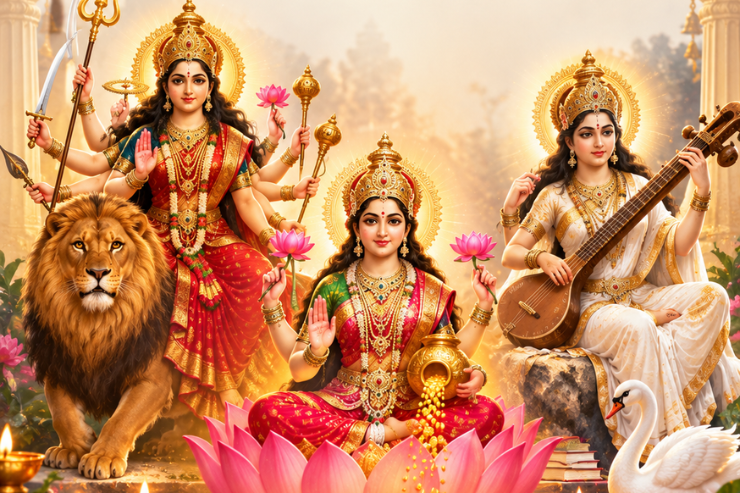
The journey begins with Maa Durga, also invoked in her form as Mahakali. She represents Kriya Shakti, the power of action. Her role is to destroy what should not exist so that something better can take its place.
She rides a lion, which represents courage. She carries multiple weapons, each one a tool to cut through a different kind of obstacle: fear, ego, weakness, and doubt.
The first three nights are a clearing. Before you can receive abundance, you must first release what is blocking it. Before wisdom can settle in, old patterns need to be removed.
Maa Durga does not come to frighten. She comes to clear the path.
The Middle Three Nights: Maa Lakshmi
Once the clearing is done, Maa Lakshmi arrives. She is the goddess of Dravya Shakti, the power of abundance. But this is wider than money. It includes health, relationships, talent, skill, opportunity, and the fullness of a well-lived life.
She is depicted seated on a lotus in flowing water. The water moves. The lotus stays steady. This is her teaching: life keeps moving, but the one rooted in grace remains stable.
The middle three nights are for receiving. For gratitude. For opening yourself to what has been waiting to reach you once the clutter of the first three nights is cleared.
The Last Three Nights: Maa Saraswati
The journey closes with Maa Saraswati. Her name carries within it two words. Saara, meaning essence, and Swa, meaning the self. She is the one who gives you the deepest knowing of who you truly are.
She is seated on a rock, steady and unshakeable. Her vehicle is a swan, which in Hindu tradition symbolises viveka, the ability to separate what is real from what is not, the way a swan is said to drink only the milk from a mix of milk and water.
The last three nights are for clarity, stillness, and the kind of knowledge that does not come from a book but from within.
What the Three Gunas Tell Us
The three phases also map directly onto the three gunas, the fundamental qualities that exist in all of nature:
| Phase | Guna | Quality |
| Durga (nights 1-3) | Tamas | Dissolution, clearing, going inward |
| Lakshmi (nights 4-6) | Rajas | Energy, abundance, outward growth |
| Saraswati (nights 7-9) | Sattva | Purity, clarity, stillness |
The progression is deliberate. You cannot skip to sattva without passing through the other two. The sequence itself is the teaching.
Why Does Saraswati Come Last?
Many bhakts wonder why knowledge comes at the end and not the beginning.
The answer is simple. True wisdom can only be received by a prepared vessel.
The first phase clears what blocks you. The second phase fills you with strength and abundance. Only then, in the final phase, are you ready to receive the kind of knowledge that actually changes you.
Saraswati does not come first because an unprepared mind cannot hold what she offers. Navratri prepares you first, then gives you the gift of clarity.
What Vijayadashami Is Really About
The tenth day, Vijayadashami or Dussehra, is celebrated as the day of victory.
Most know it as the day Rama defeated Ravana. But it is also the conclusion of Saraswati's phase, which is why in many parts of India, new learning is traditionally begun on this day. Children start new classes. Instruments are picked up. Businesses open new ledgers.
It is a day of fresh starts, because Navratri has just completed its work. You have been cleared, filled, and illuminated. Now you are ready to begin.
Observe Each Phase With This in Mind
- During nights 1 to 3: Let go. Pray to Maa Durga for strength to release what is heavy. Fast if you are able. Sit in quiet prayer.
- During nights 4 to 6: Receive with gratitude. Offer thanks for what you have. Light a diya for Maa Lakshmi and be present to abundance in all its forms.
- During nights 7 to 9: Seek clarity. Read something sacred. Sit in silence. Ask Maa Saraswati to show you your next right step.
Every Night Has a Name And a Purpose
Navratri is not nine nights of fasting. It is nine nights of becoming.
You are invited, each year, to walk through the full journey: from clearing, to abundance, to wisdom. Maa Durga, Maa Lakshmi, and Maa Saraswati are not three separate goddesses competing for those nine nights. They are three faces of the same mother, each meeting you at a different point of your own journey.
The festival lasts nine nights. The transformation, if you let it, lasts much longer.
If you wish to observe Navratri with guided puja, aarti, or a Devi Chawki, Shri Gauri Shankar Mandir, a trusted Hindu temple in Brampton, welcomes every bhakt through each of these nine sacred nights. You can also arrange your puja through online puja booking on the temple website or reach the temple at info@sgsm.ca or +1 647 870 7100.
Frequently Asked Questions
Q1. Which goddess is worshipped on which nights of Navratri?
The first three nights honour Maa Durga (Mahakali), the next three are dedicated to Maa Lakshmi, and the final three belong to Maa Saraswati. Together they represent action, abundance, and knowledge.
Q2. Why is Navratri celebrated twice a year?
Navratri occurs four times a year in the Hindu calendar, but two are observed most widely. Chaitra Navratri falls in spring, and Sharad Navratri falls in autumn. Sharad Navratri, in October, is the most widely celebrated.
Q3. What is the connection between Navratri and Vijayadashami?
Vijayadashami falls on the tenth day, immediately after Navratri ends. It marks the conclusion of Saraswati's phase and is traditionally considered ideal for beginning new learning, starting new endeavours, and fresh beginnings.
Q4. Is it necessary to worship all three goddesses during Navratri?
It is not compulsory, but understanding and acknowledging all three enriches the experience. Each phase offers a different blessing. Observing all three, even with simple daily prayer, completes the spiritual cycle Navratri is meant to offer.
Q5. Can Navratri puja be arranged at a temple in Brampton?
Yes. Shri Gauri Shankar Mandir holds special Navratri puja and aarti through the nine nights. Families can attend or arrange a private Devi puja through the temple in Brampton by contacting the temple directly or using online puja booking.