Nav Durga: The Nine Forms of Maa Every Bhakt Should Know
Every year Navratri arrives and bhakts fast, pray, and light their diyas. But how many of us truly know who we are praying to on each of those nine nights?
The nine forms of Maa Durga are not just names to recite. Each one is a different face of the Divine Mother, a different energy, a different blessing. And understanding them changes everything about how Navratri feels.
Here is a guide to all nine, so Maa's story reaches your heart.
Why Does Maa Durga Have Nine Forms?
The Divine Mother is not one thing. She is both strength and softness. Creation and destruction. Fierce warrior and gentle nurturer.
The nine forms of Nav Durga represent the full range of her power and grace. Together they trace a complete spiritual journey, from the very first step of grounding yourself in the earth, to the final step of receiving complete wisdom and liberation.
Each night of Navratri is an invitation to connect with a different energy within yourself. Because what Maa shows us in her nine forms, she is also showing us about ourselves.
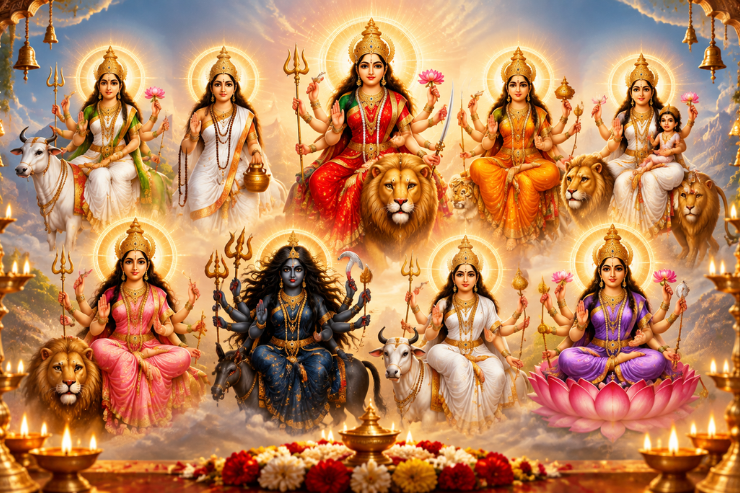
The Nine Forms of Maa Durga: At a Glance
| Day | Form | Colour | What She Governs | Prayed to For |
| Day 1 | Shailputri | Yellow | Nature, foundation, the earth | Grounding, stability, new beginnings |
| Day 2 | Brahmacharini | Green | Discipline, learning, devotion | Focus, patience, spiritual growth |
| Day 3 | Chandraghanta | Grey | Courage, inner strength | Bravery, protection from fear |
| Day 4 | Kushmanda | Orange | Creation, cosmic energy | Health, prosperity, vitality |
| Day 5 | Skandamata | White | Motherhood, unconditional love | Children's wellbeing, family harmony |
| Day 6 | Katyayani | Red | Fierce protection, justice | Strength, defeating obstacles |
| Day 7 | Kalaratri | Royal Blue | Destruction of evil and darkness | Protection from negativity |
| Day 8 | Mahagauri | Pink | Purity, peace, forgiveness | Cleansing, serenity, new hope |
| Day 9 | Siddhidatri | Purple | Wisdom, complete spiritual mastery | Blessings, moksha, divine knowledge |
The Meaning Behind Each Form Of Maa Durga
Maa Shailputri: Day 1
Daughter of the Himalayas. She holds a trishul and a lotus, power and purity together. She represents the very first step: rooting yourself in the earth before you can rise.
Maa Brahmacharini: Day 2
She walks barefoot, carrying a water pot and a rosary. She is the student, the seeker, the one willing to give up comfort for truth. She teaches that discipline is not a restriction. It is freedom.
Maa Chandraghanta: Day 3
She wears a half-moon on her forehead and carries ten weapons. She is the warrior who has left behind fear. She awakens the courage that was always inside you.
Maa Kushmanda: Day 4
Her smile is said to have created the universe. She is the cosmic mother, the origin of all light and life. She reminds us that creation is always possible, even in darkness.
Maa Skandamata: Day 5
She holds her son Kartikeya in her lap while seated on a lion. She is the mother who does not stop being fierce simply because she is loving. Her love is her strength.
Maa Katyayani: Day 6
Born from the combined energy of all the gods to defeat Mahishasura. She is the protector who rises when all other forces have failed. She is prayed to especially by those seeking courage to face something that feels too large.
Maa Kalaratri: Day 7
Her form is fierce and dark. She destroys what should not exist, ignorance, fear, evil. She is the most misunderstood of the nine, yet the most liberating. Darkness can only be defeated by something willing to enter it.
Maa Mahagauri: Day 8
After the battle, peace. Her white form shines with serenity and purity. She is the reminder that after every storm, stillness returns. She cleanses what suffering has left behind.
Maa Siddhidatri: Day 9
The final form. She sits in full bloom, surrounded by her devotees, showering them with siddhi, divine gifts and spiritual knowledge. She represents the completion of the journey. She is what you arrive at when you have walked through all the other eight.
Nav Durga and the Nine Chakras
Many bhakts do not know that each form of Nav Durga also corresponds to one of the nine chakras in the body.
| Form | Chakra | Location |
| Shailputri | Muladhara | Base of the spine |
| Brahmacharini | Swadhisthana | Lower abdomen |
| Chandraghanta | Manipura | Solar plexus |
| Kushmanda | Anahata | Heart |
| Skandamata | Vishuddha | Throat |
| Katyayani | Ajna | Third eye |
| Kalaratri | Sahasrara | Crown |
| Mahagauri | Bindu | Back of the head |
| Siddhidatri | Nirvana | Above the crown |
When you worship each form during Navratri, you are not just offering flowers to a deity. You are activating something within yourself.
How to Connect With Each Form in Canada
You do not need a large pandal or a city full of celebrations to feel Maa's presence.
- Wear the colour of the day. Even if you are going to work, a dupatta, a bracelet, or a piece of clothing in that day's colour is enough.
- Light a diya each morning and say her name. Shailputri on Day 1, Brahmacharini on Day 2, and so on.
- Chant the Nav Durga Stotram. Nine names, nine mornings. It takes less than three minutes.
- Attend the Navratri aarti at a Hindu temple in Brampton when you can. The collective energy of a temple during these nine nights is something home puja alone cannot replicate.
- Sit quietly for five minutes after your prayer and think about which form's quality you need most right now. Courage? Peace? Clarity? Ask her specifically. She listens.
Maa does not need grand gestures. She needs a sincere heart.
Maa Will Meet You Where You Are
The nine forms of Nav Durga are not nine different goddesses but nine different ways the same Mother meets her children, depending on what they need.
Some days you need Shailputri to ground you. Some days you need Kalaratri to help you face what you have been avoiding. Some days you simply need Mahagauri to tell you that the storm is over and peace is here.
Navratri is nine invitations. All you have to do is show up.
If you wish to observe Navratri with aarti, special puja, or a Devi Chawki at a temple in Brampton, Shri Gauri Shankar Mandir welcomes every bhakt through the nine sacred nights. You can reach the temple at info@sgsm.ca or call +1 647 870 7100. Online puja booking is also available through the temple website for those who wish to plan ahead.
Frequently Asked Questions
Q1. What are the nine names of Nav Durga in order?
Shailputri, Brahmacharini, Chandraghanta, Kushmanda, Skandamata, Katyayani, Kalaratri, Mahagauri, and Siddhidatri. Each is worshipped on one of the nine nights of Navratri in this sequence.
Q2. Why does each day of Navratri have a different colour?
Each colour corresponds to the energy and qualities of that day's form of Maa Durga. Wearing the colour is a way of aligning yourself with her energy for that day, even if you are not fasting or attending a puja.
Q3. Which form of Nav Durga is most powerful?
All nine are equally divine as they are forms of the same mother. However, Kalaratri is considered the most intense form, while Siddhidatri is believed to bestow the highest spiritual blessings including moksha.
Q4. Can Nav Durga be worshipped at a Hindu mandir in Brampton during Navratri?
Yes. Shri Gauri Shankar Mandir holds special prayers and aarti during Navratri. Devotees can attend daily aarti or arrange a special Devi puja through the temple for any of the nine nights.
Q5. Is it necessary to fast all nine days of Navratri?
No. Fasting on all nine days is a choice, not a requirement. Many devotees fast on only the first and last days, or on specific days meaningful to them. Sincere prayer and devotion matter more than the number of days observed.